Case Study · EdTech
AlmaBetter's Climb to #1 in Data Science Education SEO
AlmaBetter had strong student outcomes and solid course content. But they were invisible on Google. For searches like "data science certification program" and "best data science course in India," the same few giants showed up every time. upGrad. Simplilearn. AlmaBetter was nowhere. In 12 months, we changed who showed up at the top.
 AlmaBetter - outcome-driven tech education with job assistance. Strong student outcomes, strong course content. Zero search visibility when we started.
 A quality course provider that search engines could not see.
If you are running an EdTech company, you know this feeling. Your curriculum is excellent. Your student outcomes are strong. Your placement numbers beat the big names. But when someone searches for exactly what you teach, those big names show up. Not you. Every month you spend on ads because organic does not deliver. Every enrollment costs you money that could have gone into better content, better faculty, better outcomes. AlmaBetter was in exactly this position. Great product. Zero visibility. Watching upGrad and Simplilearn take every search while their own enrollment team asked why the website was not pulling its weight.
This is not a product problem. It is a discovery problem. And it is fixable.
What they had tried before us
AlmaBetter had worked with another agency before us. That agency charged a monthly retainer. They sent a report every 30 days. It was 40 pages long. It showed "impressions up 12%" and "clicks up 8%." It had charts. It looked professional. But after months of paying, AlmaBetter's enrollment numbers from organic search had not moved. Not one new student came through Google. The agency kept sending reports. The reports kept looking positive. The results kept not arriving.
This happens because most agencies optimize for retention, not results. They pick metrics that always trend up - impressions, clicks, "brand awareness." Things that sound good in a report and cost nothing to report on. What they do not measure: how many students actually enrolled because they found you on Google. That number is harder to inflate. So they do not report it.
When we audited the site, we found the problem immediately. The previous agency had been targeting broad educational keywords like "data science" and "machine learning course." These terms get searched millions of times. They also have massive competition from sites with 10-year head starts in authority. You cannot outrank Wikipedia and Coursera with a 500-word blog post. But that did not stop the agency from trying - and billing - month after month.
Strategy first. Execution second.
Here is what most EdTech companies end up doing: they publish blog posts about industry trends, share them on LinkedIn, and hope Google eventually notices. Or they hire an agency that publishes the same kind of posts, sends pretty reports, and collects a check. That is not a strategy. That is being managed. Here is what we did instead.
Find the gaps the giants are too big to notice
The upGrads of the world fight over the same 50 head terms. "Data science course." "Best certification program." The bidding war never ends and the content war is just as intense. We looked elsewhere. Searches like "data science course with job guarantee" and "affordable data science certification" had real purchase intent - these are students ready to enroll, not just browsing. But the big players were too busy defending their head terms to optimize for them. We mapped over 500 keywords where intent was high but competition was low. That became the foundation.
Make sure Google can actually read your content
You can publish the best educational content in the world. If Google cannot crawl it efficiently, none of it ranks. Crawl errors, broken internal links, missing schema markup - these are not exciting problems. They are also the reason most EdTech sites underperform regardless of content quality. We fixed every one.
Answer every question a prospective student asks
A student considering a data science course has dozens of questions. What will I learn? What is the salary after? Which program is better, this one or that one? Can I get a job without a degree? Each question is a search. Each search is a potential enrollment. We built over 100 pages targeting every stage - from "what is data science" to "AlmaBetter vs upGrad placement comparison." Every page answered one specific question.
Your students are on their phones. Your site needs to work there.
Most prospective students in India research courses on mobile. If your pages are slow, cramped, or hard to read on a phone, they leave before they even see what you offer. We optimized every page for mobile experience, speed, and readability. Title tags, meta descriptions, header hierarchy - all rebuilt around the keywords students actually search.
Get the right people to vouch for you
Google trusts what other trusted sites say about you. We earned 150+ backlinks from tech publications, education platforms, and industry sources. Not directories. Not paid links. Real publications that real students and professionals read. Each one told Google: this institution is legitimate.
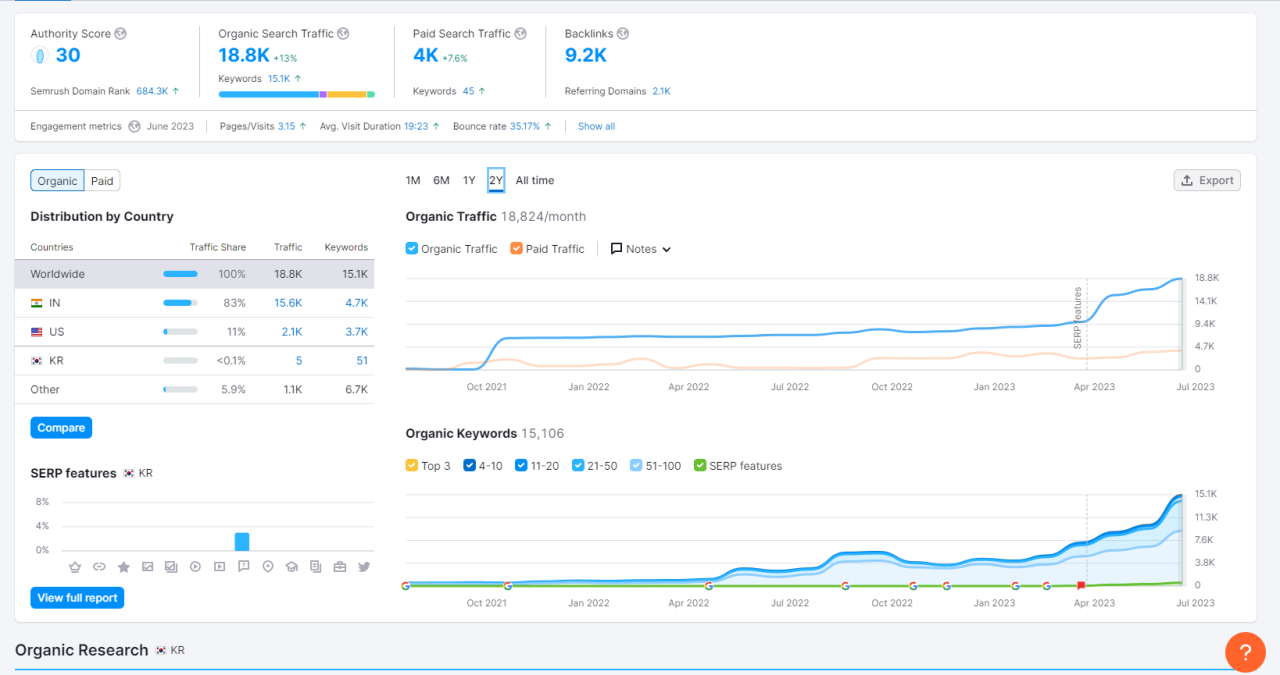 SEMrush dashboard. 1K+ keywords ranked. #1 for the primary target. This is not a spike from one campaign. It is 12 months of consistent work compounding into a trajectory that keeps climbing.
 What happened after deployment
Within 12 months, AlmaBetter hit #1 for "Data Science Certification Program" in India. They ranked for over 1,000 keywords. Visibility on their highest-converting landing pages tripled. Here is what that actually meant for the business: enrollment inquiries from organic search became a consistent, growing channel. The dependency on paid ads started to drop. Every month, the content we built compounds further - ranking for more terms, driving more qualified traffic, generating more enrollments. All without increasing ad spend. This is what happens when discovery stops being your bottleneck.
SEMrush dashboard. 1K+ keywords ranked. #1 for the primary target. This curve is not a spike from one campaign. It is 12 months of consistent work compounding. Every EdTech founder wants this trajectory. It is achievable when the strategy matches the student journey. What this means for your EdTech company
You do not need a bigger ad budget than upGrad. You need a smarter keyword strategy. AlmaBetter won by targeting the high-intent searches the giants were too big to notice. Your competitors have the same blind spots. Find them and you compete on content quality, not spending power.
If your site has technical issues, your content is invisible regardless of quality. Many EdTech companies invest heavily in curriculum and course content but underinvest in the technical foundation that lets Google find it. Fix crawl errors, structure your topic silos, and every piece of content you publish starts working harder.
Student acquisition cost from organic search approaches zero over time. Paid ads scale linearly - more students costs more money. Organic compounds - the same content keeps producing enrollments month after month at no additional cost. 12 months to #1. The investment pays for itself many times over once the rankings are established.
Trust is your conversion bottleneck, not your course quality. Students research for weeks before enrolling. Every search during that window is a chance for your brand to show up as the authority. The institutions that appear consistently across the student journey win the enrollment. Those that do not, lose to whoever does.